The Bojin Journal · Cheeks & Smile Lines
Mouth Corners Turning Down? What's Really Happening
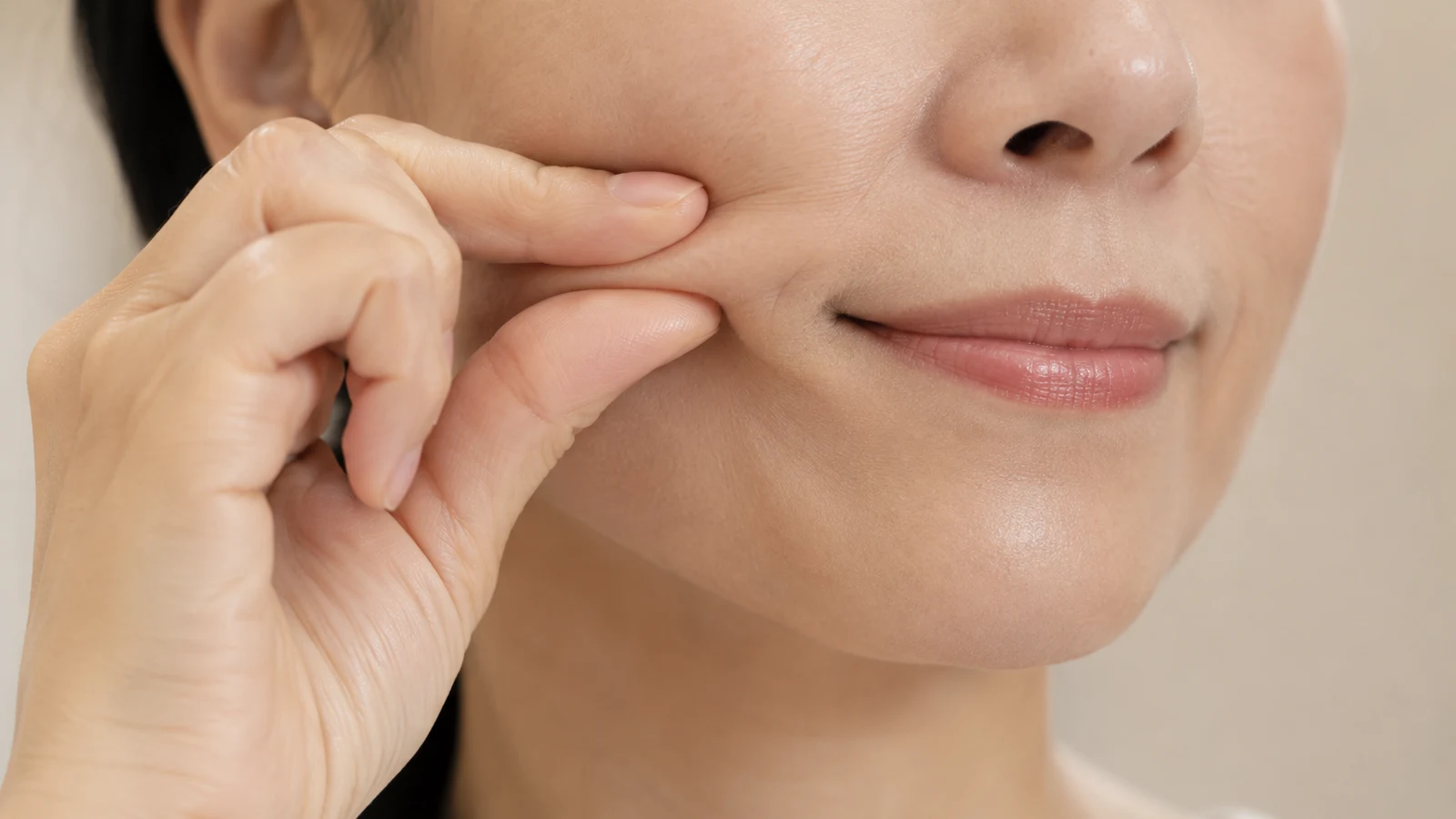
Has anyone asked if you were upset when you weren't? My students name that moment more often than any line or crease: a coworker, a husband, a stranger reading a perfectly calm face as a sad one. The lines running from the corners of your mouth toward your chin, the ones catalogs call marionette lines, create that misreading. Two separate pulls draw those corners down. You can reach one of them.
Two pulls, one direction
Advice about this area tends to fail because it treats two problems as one. Split them apart and each becomes clear.
Pull one is structural: the support under the mid-face loosens over years, and the corners of the mouth settle lower with it. Pull two is a habit: the small depressor muscles at each corner stay lightly engaged through hours of concentration, drawing the corners down even at rest. Your hands cannot reach the first pull. They can reach the second, and the second carries more of the look than most women guess.
Try this in a mirror. Smile, then let your face drop to full rest, no expression, jaw soft. Watch the corners. A visible drop the instant you release, deeper than gravity alone explains, is the muscle habit announcing itself. That drop is your working target. If you notice it's more pronounced on one side, that's worth a closer look too: see why one side of your face looks different from the other.
Where the habit comes from
Concentration. When you read, scroll, or focus, the corners of the mouth draw down and in without a single conscious frown. Repeat that for hours a day across years and the muscle learns the position as home. It holds the corners there through dinner, through conversation, through the photo where everyone asked why you looked so serious.
A 5-minute release for the mouth corners
Use oil or your usual moisturizer. The skin here is thin, moves easily, and needs glide far more than pressure.
- Memorize your resting position Let your face go slack in the mirror and note where the corners sit. This is your before, and your only honest measure of after.
- Work the corner at an upward angle With a fingertip or the rounded tip of a stone, make short passes right at the corner, angled up toward the ear. You are showing the muscle the direction it forgot.
- Trace the line itself Follow the crease from corner toward chin with light upward strokes, a few passes per side. Light. The line needs coaxing, not erasing pressure.
- Lift the lower cheek above it The tissue above the corner helps hold it up. A few upward passes along the lower cheek support what you just released.
- Check your resting position again Go slack the same way as step one. Corners sitting even slightly higher at rest means you reached the habit, and that comparison, not the mirror at noon, is your progress report.
The honest ceiling
This release eases the habit pull, and consistent practice keeps it eased, gently and temporarily, never permanently. It rebuilds nothing. The structural pull stays where the years put it, and no hands-on method moves it. If the corners trouble you enough to consider a procedure, try this honest five minutes first or alongside, and let a professional consultation stand on its own merits. The two answers don't compete.
The next time someone asks if you're upset, you'll know which part of that impression is a habit your hands can unlearn, and which part was never yours to fix in five minutes. That knowledge alone changes how you look at the mirror.
Quick answers
People keep asking if I'm upset. Can this actually help?
It can ease the muscle-habit half, and for many women that habit carries more of the resting expression than they assumed. A neutral face with released corners reads more neutral. The structural half stays; treat this as reclaiming the part within reach, not erasing the whole look.
Are marionette lines the same as smile lines?
Neighbors, not twins. Smile lines run from the nose to the mouth corners. Marionette lines pick up where those end, running from the corners down toward the chin. The two often deepen together, which is why the cheek release pairs well with this one.
Can I do anything about the loosening-support part?
Not with your hands. That half is structural change over years, and a gentle method does not reverse it. The honest move is to work the muscle-habit half well and let a professional conversation cover anything beyond it, if you ever want one.
Will smiling more help?
The downward pull does its work between expressions, while you read, scroll, and concentrate, so a conscious smile misses it. A short release aimed at the resting pull reaches what smiling can't, and no one can smile through a Tuesday anyway.
See the upward angle for yourself
Stroke direction decides everything at the mouth corners, more than anywhere else on the face. My free 3-minute video shows the exact upward angle, so your first session works with the corner instead of against it.
Watch the free 3-min videoYu-Ting Lan is a Taiwan-based international bojin instructor and the founder of Héhé Studio. She has taught her bojin method to more than a thousand students, from complete beginners to grandmothers, across Taiwan, Hong Kong, and Malaysia.