The Bojin Journal · Cheeks & Smile Lines
Are Nasolabial Folds Permanent? An Honest Answer
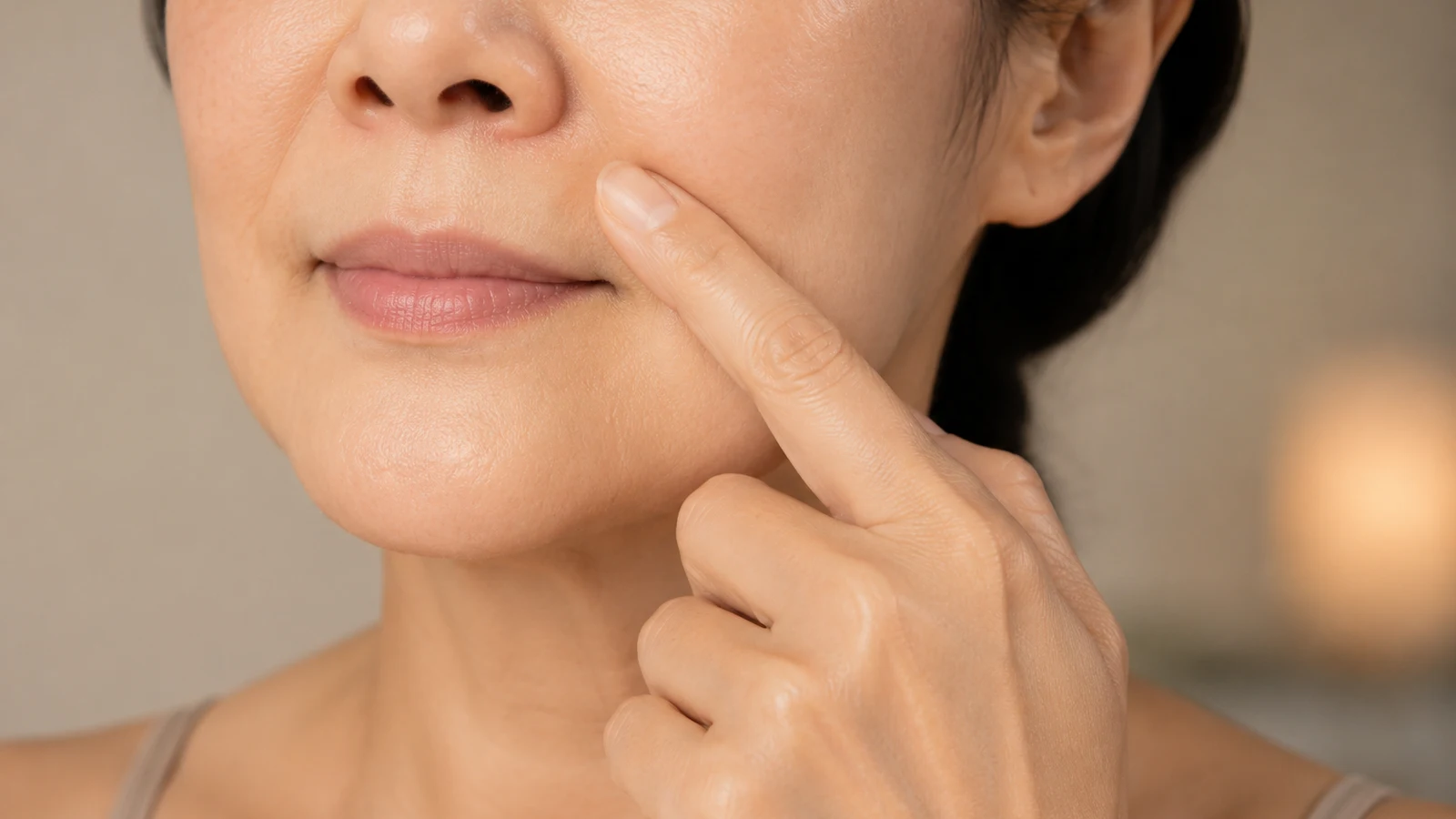
"Just tell me the truth," a student said, pressing the line that runs from her nose down past the corner of her mouth. "Is this ever going away, or am I stuck with it?" She'd earned a straight answer, and the straight answer is: partly stuck, partly not. The trouble is that most advice treats the nasolabial fold as one thing, when it's really two things stacked together, and only one of them is yours to change by hand.
The hinge and the pillow
Picture the fold as a hinge in a piece of upholstery, with a pillow of stuffing behind the cheek above it. Two separate things decide how deep the fold looks. The hinge is the crease itself, held tight by the tension of the cheek and mouth muscles and made to look deeper when the cheek above puffs with fluid. The pillow is the cushion of youthful volume that used to sit high in the cheek and hold everything up. Over the years the pillow flattens and slides down, and the hinge creases harder because there's less holding it open.
A deep nasolabial fold is a tense hinge plus a deflated pillow. Your hands can ease the hinge, the tension pulling the crease tight and the fluid puffing the cheek above it. Your hands cannot re-stuff the pillow. So the fold can genuinely soften, but it won't vanish, and anyone promising vanish is selling the pillow you can't buy back this way.
This is also why the cream never worked. A cream sits on the surface, and neither the hinge nor the pillow lives on the surface. You were treating the wrong layer.
What softening the hinge actually looks like
Here's the honest, useful part. When you ease the tension that keeps the crease pulled tight, and you move the fluid that puffs the cheek above it, the fold reads shallower, because a soft hinge under a de-puffed cheek simply casts less of a shadow. It's real, it's visible, and it's gentle and temporary, building with consistency. It is not the pillow coming back. Hold both truths at once and you'll be happy with the result instead of disappointed it wasn't magic.
A 5-minute fold-softening release
Use a little oil or moisturizer for glide, and work with a fingertip or the rounded tip of a stone.
- Lift the cheek above the fold first Several slow upward passes on the cheek, from beside the nose out and up toward the cheekbone. You're settling the puffy part that deepens the fold by contrast.
- Trace alongside the fold, not into it Run light strokes just outside the crease, along the cheek side, rather than digging into the line itself. You're releasing the tension that holds the hinge tight.
- Ease the mouth corner A few gentle upward passes at the corner of the mouth, since the muscles there pull on the lower end of the fold.
- Warm the whole cheek Broad, unhurried passes across the mid-face to bring circulation and a little plumpness to the area, which softens how the fold reads.
- Finish down and out Sweep from the cheek down toward the ear and along the neck, giving any fluid you moved a route away from the fold.
Where filler fits, honestly
If your fold is mostly the deflated pillow, a gentle release will soften the hinge and you may still want more. That's a fair, personal decision, and a conversation for a qualified professional, since filler addresses the volume part directly in a way hands never will. None of that is a reason to skip the gentle route. It costs you a few minutes a week, it eases a real part of the look, and it's a sensible thing to try first or alongside, not instead of, a professional consultation.
So: partly stuck, partly not. You can't rebuild the pillow with your hands, but you can soften the hinge, and a softer hinge is most of what makes the fold read gentler in the mirror. That's the honest answer she wanted, and it's a better one than "gone for good" in either direction.
Quick answers
So are nasolabial folds permanent or not?
Everyone has the fold to some degree; it's part of how the face is built, and in that sense it's permanent. How deep and set it looks is partly changeable. The tension-and-fluid part responds to gentle work, while the volume-loss part behind it doesn't, so the honest answer is: softer, yes; gone, no.
Why don't creams do anything for mine?
A cream sits on the surface, and a deep fold is a matter of what's happening underneath, the crease itself and the loss of cushion behind it. Moisture can make the skin along the fold look a little smoother, but it can't reach the mechanics of the fold, which is why the jar disappoints.
Which part can a gentle release actually help?
The hinge part: the tension in the cheek and around the mouth that keeps the fold pulled tight, and the fluid that puffs the cheek above it so the crease looks deeper by contrast. Ease those and the fold softens. The lost cushion behind it is the part hands can't restore.
Should I just get filler instead?
That's a personal choice and a conversation for a qualified professional, not something to decide from a blog. Filler addresses the volume part directly. A gentle release addresses the tension-and-fluid part gently and temporarily. They're not the same job, and trying the gentle route first costs you nothing but a few minutes a week.
See where to work, and where not to
The trick here is working beside the fold, not in it, and lifting the cheek above it. That's far clearer shown than described. My free 3-minute video walks the exact path.
Watch the free 3-min videoYu-Ting Lan is a Taiwan-based international bojin instructor and the founder of Héhé Studio. She has taught her bojin method to more than a thousand students, from complete beginners to grandmothers, across Taiwan, Hong Kong, and Malaysia.