The Bojin Journal · Root cause & tension chains
The Screen-to-Forehead Chain: Where Those Lines Actually Come From
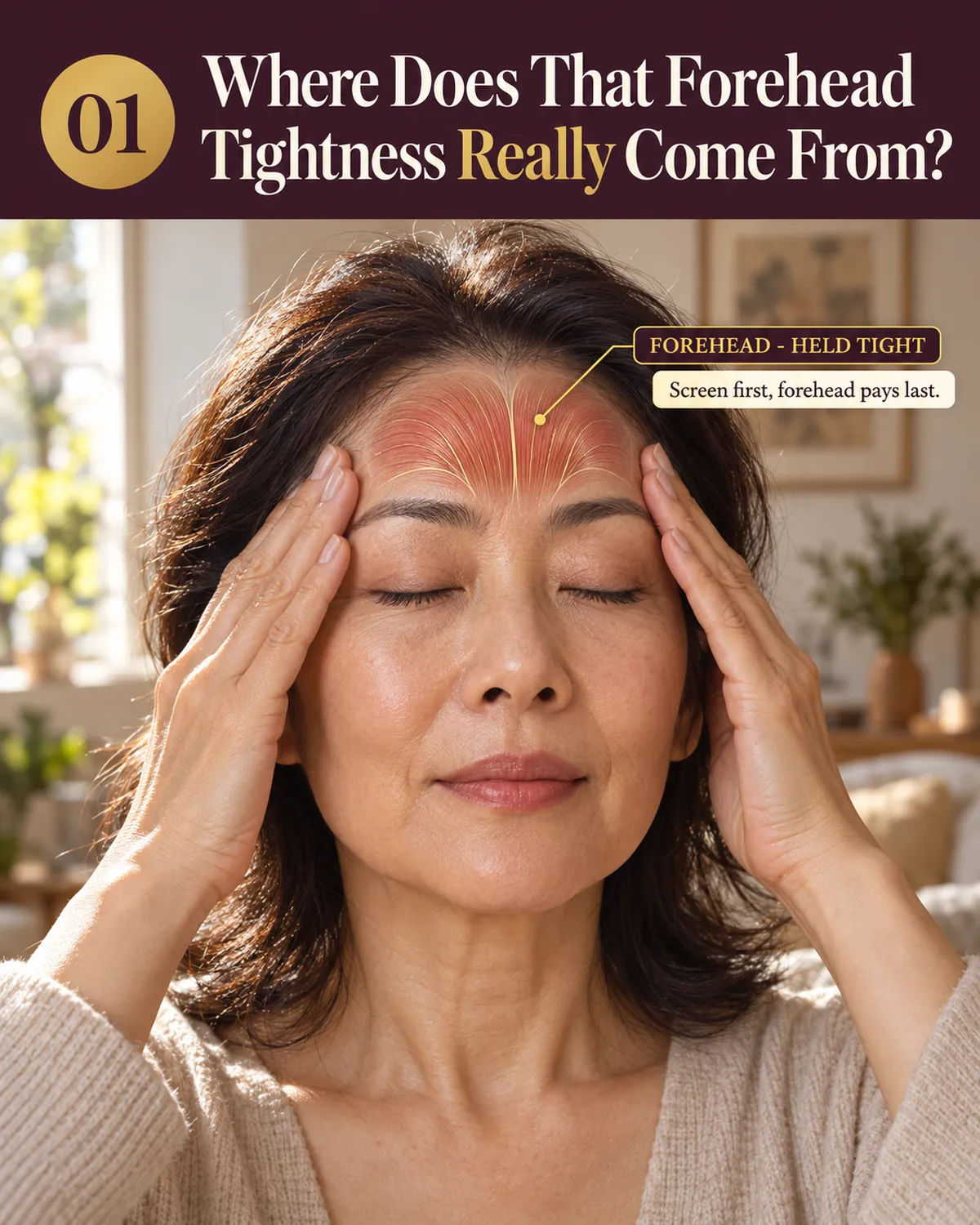
It's four in the afternoon and your hand is on your forehead again, rubbing at that tight band above your brows. The horizontal lines look deeper than they did at breakfast. You start to wonder whether the computer is carving them in.
- Forehead tightness is usually the last link in a four-part chain that starts at your screen, not a sign your skin is aging faster.
- Screen asks too much → eyes strain → brows lift to help → forehead holds that lift for hours, that's the whole chain.
- Rubbing your forehead treats the last link only, the relief is real but brief because the lift restarts the moment you look back at the screen.
- Bojin works temples and brows first, forehead last, paired with bigger text and a checked prescription.
You reach for the forehead because that is where the tightness announces itself. But more than a decade of teaching this work in Taiwan has shown me that the forehead is the last link in this chain, almost never the first.
The chain starts on your desk, with a screen that asks a little too much of your eyes, hour after hour. Your forehead pays the bill at the end of the day.
The chain runs in the opposite direction than you'd guess
When a student tells me her forehead feels tight by evening, I don't ask about her forehead. I ask about her screen. How big is the text? How far away does it sit? When did she last have her glasses checked?
The questions sound like tech support, but they are the whole story. Forehead tension from computer screen work follows a chain with four links, and the forehead only holds the receipt.
Link one: the screen asks too much. The text is a size too small, the screen sits a little too far away, or glare from a window washes half of it out. Any one of these turns ordinary reading into a low-grade effort, repeated thousands of times a day.
Link two: your eyes strain to keep up. The small muscles around your eyes narrow and grip. You squint without ever deciding to squint, dozens of times an hour.
When squinting is not enough, your face sends reinforcements, and you never chose this. It is automatic compensation.
Link three: your brows lift to help. The broad muscle across your forehead raises your brows to hold your eyes wider open, trying to let more of the screen in.
Link four: your forehead holds the lift, for hours. That muscle is the only one that can keep your brows raised, so it braces from your first email to your last. By evening it feels tight and heavy, and the horizontal lines look more pressed in.
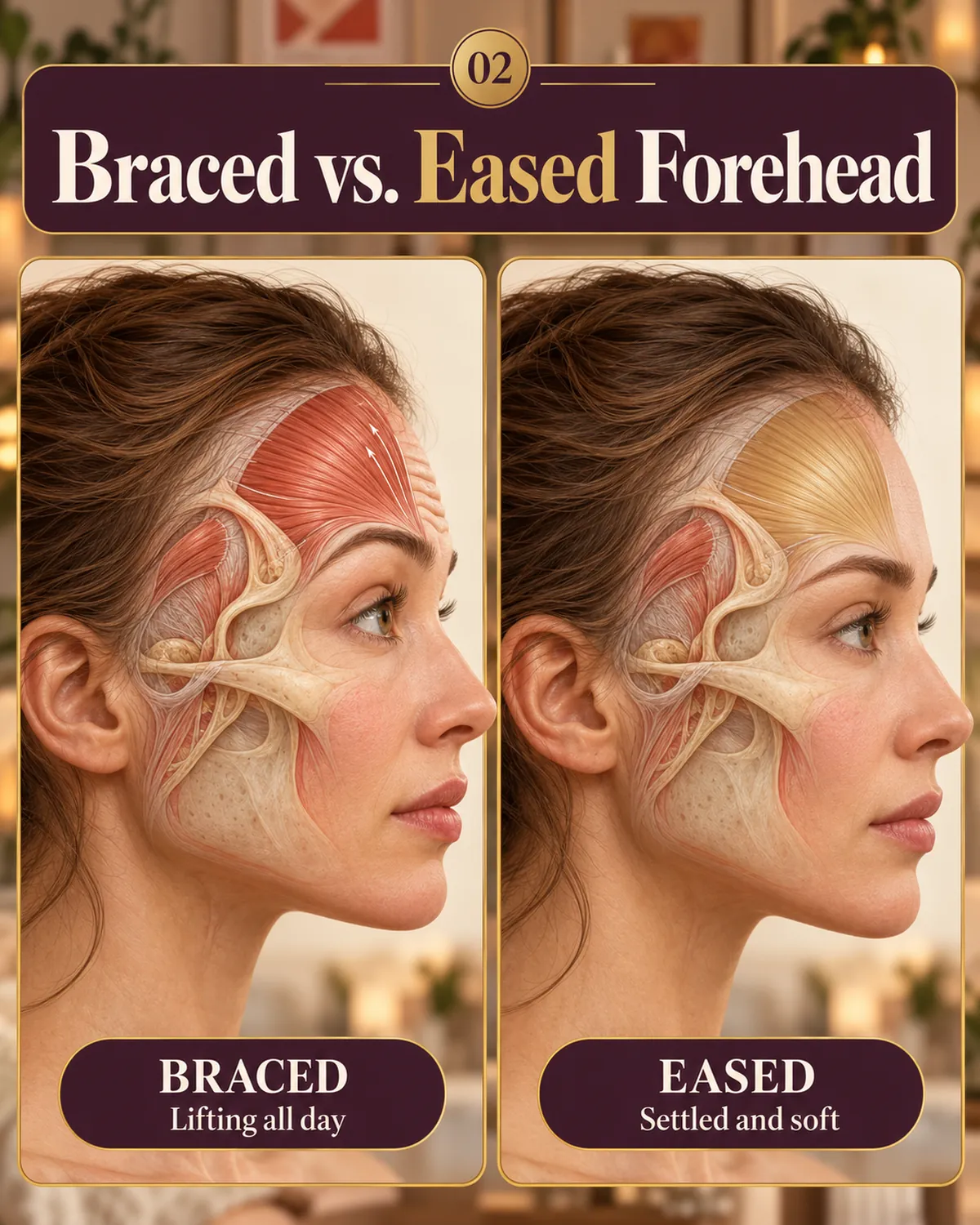
Four links, one chain. And you have been rubbing the fourth link and wondering why the tightness keeps coming back.
Find the smallest text on your screen and read it for ten seconds, paying attention to your brows. Most people catch them creeping upward. Now make the text two sizes bigger and read the same words. Feel your brows settle back down? That small drop is the whole chain, demonstrated.
Why rubbing the last link disappoints
Rubbing your forehead at four in the afternoon is like mopping the floor with the tap still running. The relief is real and brief, because the lift starts again the next time your eyes meet the screen.
This all-day bracing explains another frustration my students mention often. Product seems to sit on top of a tense forehead and eye area instead of settling in. If your eye cream never seems to absorb, the holding you are reading about here is often part of that story.
Where bojin comes in
Bojin is the method I teach for the first half. It is built on three decisions: the order you work in, the angle you hold, and the position you land on, plus the right comfortable pressure. Gua sha is a tool. Bojin is a method. Different jobs, not a contest.
Since the forehead is the end of the chain, we never start there. We begin where the compensation begins, near the eyes and temples, and reach the forehead last, so the holding has somewhere to go.
The tool I teach with is a stainless steel bojin stick, with a broad edge for the forehead and a rounded tip for the temples. It is coming soon. Tonight, the jade or rose quartz gua sha stone already in your drawer will do fine, because the value lives in the method, not the object.
A short evening sequence for screen days
Plan on ten minutes, two or three times a week, ideally at the end of a screen-heavy day. Clean skin and a few drops of facial oil so the tool glides. Never work on dry skin, and never put the tool on your eyelids.
- Close and rest Eyes closed, warm palms resting over them for three slow breaths. You are ending the asking before you ease the holding.
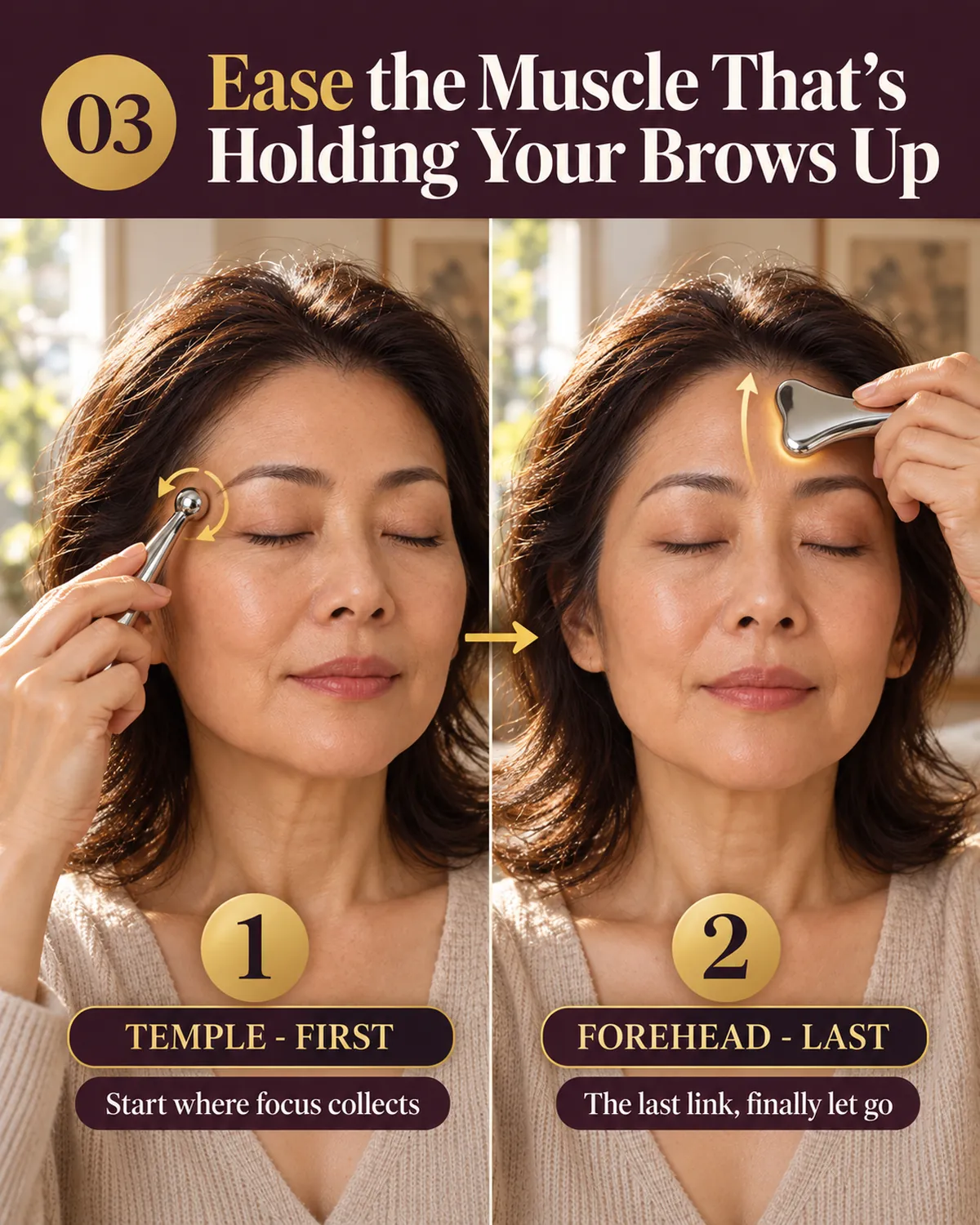
- Temples first Rest the rounded tip at each temple and make slow, light circles. This is where screen focus quietly collects.
- Then the brow bone With the rounded tip, glide from the inner end of each brow outward toward the temple, staying on the brow itself and off the lid. Three or four slow passes per side.
- Forehead last Lay the broad edge nearly flat and glide from the brows up toward the hairline in slow strips, one section at a time.
- The pressure rule Not featherlight, not forceful. Enough to meet the tight band, never enough to hurt, lighter is always the answer when you are unsure.
Fix the first link, or the chain rebuilds tomorrow
This is the part no tool can do, and it may matter more than the sequence above.
Raise your text size and keep it raised. Most computers scale everything to 125 percent in a single setting, and the brow check you did earlier shows why it helps.
Have your glasses checked, especially if squinting has become your normal. An outdated prescription makes your brows do work your lenses should be doing.
Pull the screen to a comfortable distance and cut the glare. Then let your eyes leave the screen regularly. A short look at something far away lets the whole chain stand down for a moment.
What this can honestly do
Let me be plain, because forehead lines attract more false promises than almost any other part of the face. This practice can ease the held, braced feeling that a screen day builds into your forehead. The effect is gentle and temporary, and it works alongside the habit changes, never instead of them.
It will not remove a line that is present when your face is fully at rest. That line is structural, and no stick or stone changes it. What you are easing is the daytime holding that sits on top, and easing that is a real, modest, worthwhile thing.
Your forehead has been reporting on your screen all along. Now you know how to answer somewhere other than the last link.
Quick answers
Why does my forehead feel tight after computer work?
Because your brows have likely been lifting for hours to help your eyes see, and the broad muscle across your forehead is what holds that lift. The tightness is accumulated effort, and it eases when the effort stops, which is what larger text and a short session give you.
Will this make my forehead lines go away?
No. A line that remains when your face is fully relaxed is structural, and no at-home tool changes it. What this can do is gently and temporarily ease the daytime bracing that sits on top of those lines, so your forehead feels less held by evening.
Do I need the bojin stick for this?
No. Start with the gua sha stone you already own and follow the order above, temples and brows before forehead. The stainless steel stick adds a broad edge and a precise rounded tip, and it can come later if you want it.
How often should I do the sequence?
Two or three evenings a week is plenty, and daily sessions are not better. The habit fixes are different, larger text, a current prescription, and regular breaks work every day, because they quiet the chain at its first link.
Find Your Tightest Link (2-Min Quiz)
Everything here assumes your chain ends at the forehead, and for many screen workers it does. Take my two-minute quiz to find where your face actually holds its day.
Take the Face Tension Quiz & Get My Custom Protocol →Free · 2 minutes · Your custom protocol, sent to your email
Yu-Ting Lan is a Taiwan-based international bojin instructor and the founder of Héhé Studio. She has taught her bojin method to more than a thousand students, from complete beginners to grandmothers, across Taiwan, Hong Kong, and Malaysia.