The Bojin Journal · Root cause & tension chains
The Tightness in Your Scalp Is Showing Up on Your Face
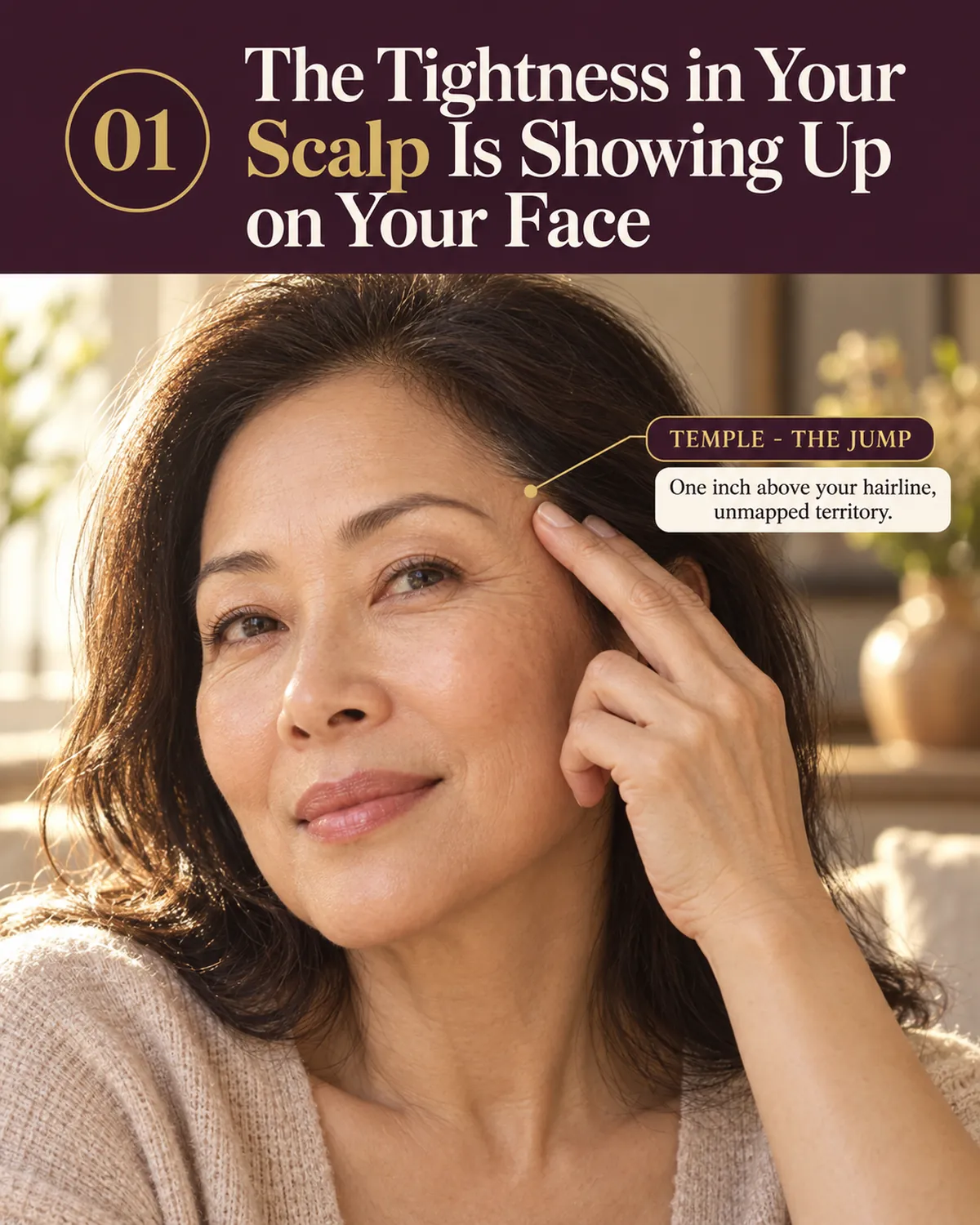
Press two fingers lightly against your temple and clench your back teeth. Feel that small jump under your fingertips? That little movement is the whole story of this article.
- A thin sheet of muscle runs from your eyebrows over your scalp to the back of your head, like a fitted bedsheet, when one end braces, the other loses its slack.
- Jaw clenching keeps the muscle above your ears switched on for hours, so your forehead has to work harder just to hold your brows up.
- The fix starts at the jaw, then the scalp, and only reaches the forehead and temples last, and lightly.
- Temples never get firm pressure, from anyone, ever, that's the one rule that doesn't bend.
Most of us have no relationship with our scalp. It grows hair, it gets washed, and we never think about it again. Yet when my students tell me their brows feel heavy or their forehead feels stiff by mid afternoon, the place I check first sits about one inch above the hairline, in territory they have never once considered.
I have taught bojin in Taiwan for more than a decade, to nearly a thousand students. The scalp is the area they overlook most, and it is often the area their face has been waiting for.
The muscle layer hiding under your hair
Your scalp is more than skin. Under the hair sits a thin, continuous sheet of muscle and connective tissue that begins at your eyebrows, climbs your forehead, crosses the crown of your head, and anchors at the back of your skull.
Think of a fitted bedsheet. Stretch one corner tight and the opposite corner has nothing left to give.
The front section of that sheet is the muscle that lifts your eyebrows. Here is the part almost nobody knows: it can only lift well when the rest of the sheet behind it has some slack. When the top and back of your scalp are braced, your forehead is trying to raise your brows against a sheet with no give in it.
My students often describe this as "I feel like I can't lift my eyebrows," and they always point at their forehead when they say it. The tightness they mean usually lives higher up, in scalp they have never touched.
Where your jaw joins the story
Now back to that jump you felt at your temple. The muscle under your fingers there is one of your chewing muscles. It spreads like a fan above your ear, and most of it hides beneath your scalp.
Every time you clench, it fires. If your teeth stay quietly touching through the workday, that fan stays switched on for hours, and the scalp above your ears braces along with it.
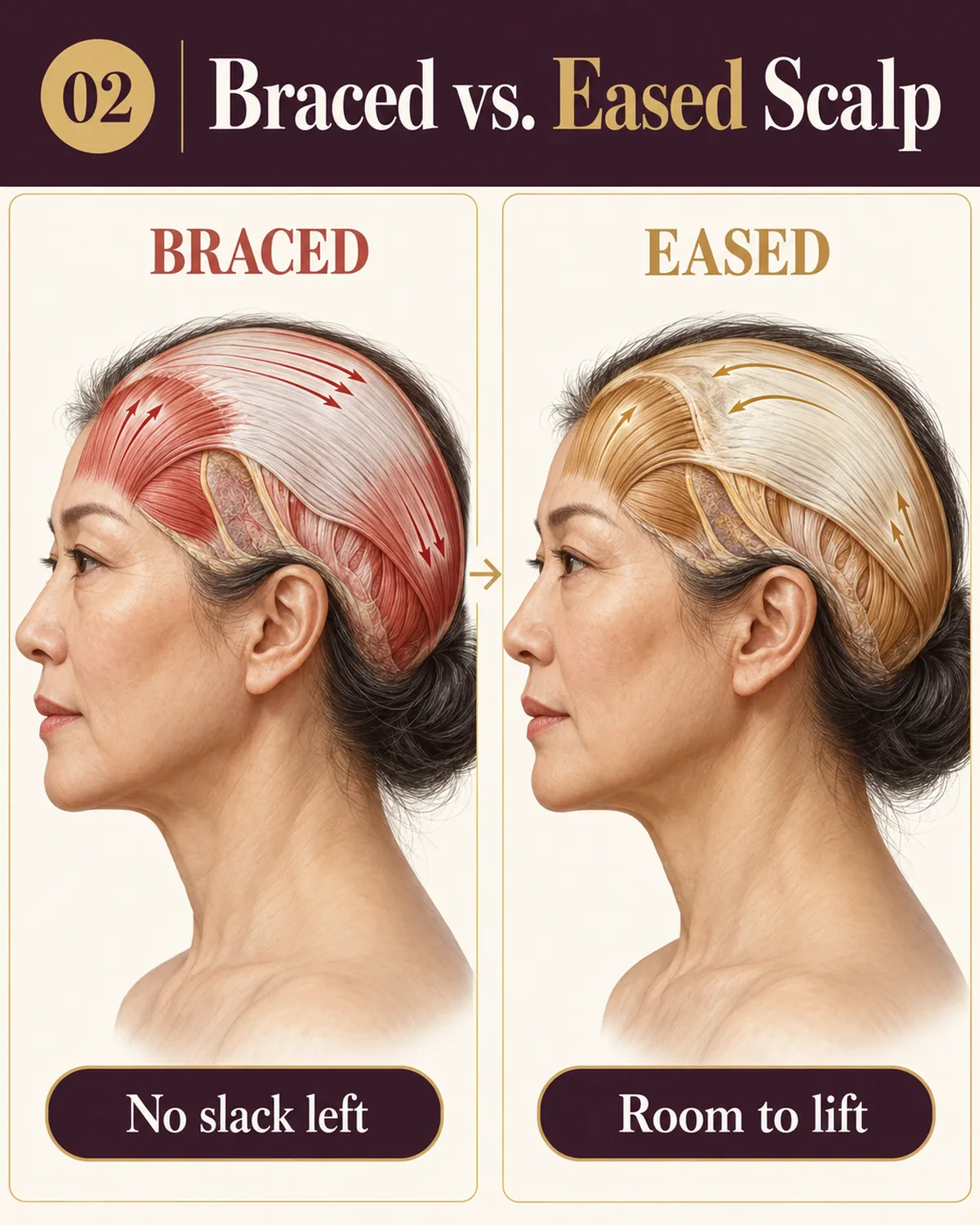
This is compensation, and it runs in a loop. The jaw grips, so the sides of the scalp brace. The scalp braces, so the forehead works harder to hold the brows up. The forehead tires, your eyes look heavier, you squint a little more, and the loop goes around again. Screens feed it all day, a path I trace in how screen time reaches your forehead.
Place your fingertips flat on your scalp just above your ears and move the skin in small, slow circles. A supple scalp slides easily over the bone underneath, a braced one feels glued down. Then raise your eyebrows as high as they go and notice where the effort happens.
Where bojin comes in
Bojin is the method I teach for connected tension like this. If it is new to you, what is bojin explains it properly. The short version: a method built on order, angle, and position, plus the right, comfortable pressure. Bojin is the method, gua sha is a tool, and those are different jobs, not a contest.
Order matters most here. If the jaw is feeding the bracing, then starting at your forehead means starting at the wrong end. We quiet the jaw first, then the sides of the scalp, and the forehead and temples come last, once the sheet behind them has softened.
I teach with a stainless steel bojin stick, which has a broad edge and a rounded tip. It is coming soon, and you do not need to wait for it. Your fingertips work beautifully on the scalp, and the gua sha stone you already own handles the jaw and forehead.
A gentle sequence for scalp and face
Plan on eight to ten minutes, two or three times a week. Not daily. Use a few drops of facial oil on the face. The scalp stays dry, fingertips only.
- Unclench before you begin Let your back teeth come apart and your tongue rest loose. One slow breath. Start from the softest version of yourself.
- Quiet the jaw With the stone's broad edge, glide gently along your jawline from chin toward ear, a few slow passes per side.
- Above the ears Fingertips flat on the scalp, small slow circles, moving skin over bone rather than rubbing the hair. Six or eight circles, then shift up slightly and repeat.
- The hairline strip With fingertips, work along the band about one inch above your hairline, from the center outward. This is the "can't lift my eyebrows" territory.
- Forehead and temples last, and lightly Sweep the stone from your brows up toward the hairline. Finish at the temples with flat fingertip pads and the lightest, slowest circles of the whole sequence. If it hurts there, stop.
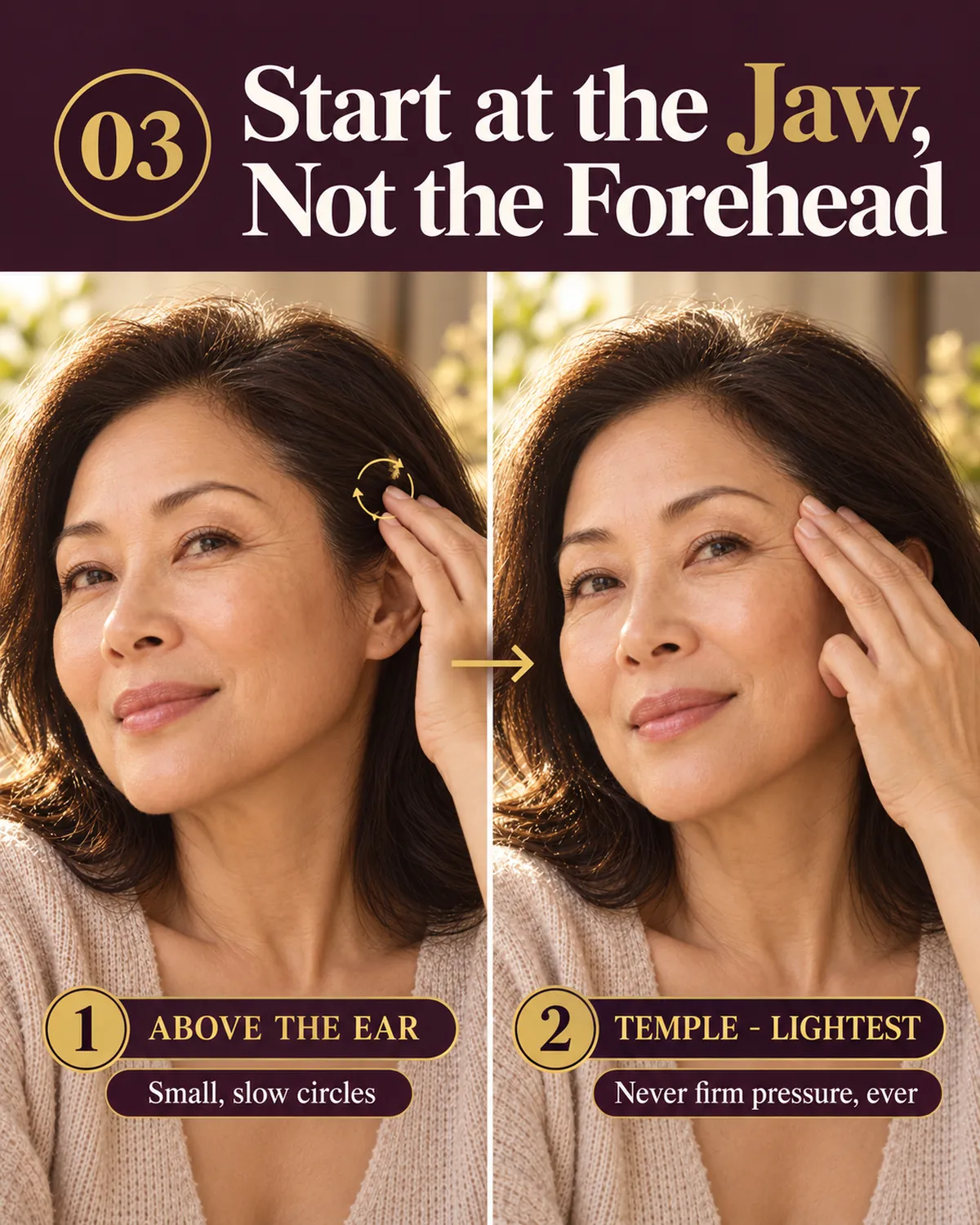
Everywhere else, pressure follows one rule: enough to reach the tension, never enough to hurt. My full guide lives at how much pressure.
What to expect, honestly, and one clear line
After a session, the scalp usually feels lighter and less glued down, the brows feel easier to lift, and the forehead feels more willing to move. The effect is gentle and temporary. It fades, and it returns as you keep the weekly rhythm.
It will not erase forehead lines that are present when your face is fully at rest, and it will not change how your brows are built.
Your scalp has been quietly holding on all this time. Now you know where to look.
Quick answers
Why does my scalp feel tight in the first place?
For most of my students it is accumulation. Hours of concentration, screen focus, and quiet jaw clenching teach the thin muscles under the scalp to brace. If the tightness is painful, constant, or comes with other symptoms, have a doctor look before assuming it is habit.
Can bojin help my headaches?
That is not a claim I make. What this practice can honestly do is help a tight scalp and braced temples feel softer for a while. Frequent or unusual headaches are a medical question, and the right first step is your doctor, not a tool.
My temples feel the tightest. Should I press harder there?
No. The temples get the lightest touch in the entire sequence, flat fingertips and slow circles only. Pressing harder where it feels tighter is the most natural instinct in this work, and it is wrong everywhere, especially there.
Do I need a tool for my scalp, or are fingers enough?
Fingers are genuinely the best tool for the hair-covered scalp, so you can start tonight with nothing. The gua sha stone you already own covers the jaw and forehead, and the stainless steel bojin stick can come later if you want it.
Find Your Tightest Link (2-Min Quiz)
Every face runs its own version of this loop. Take my two-minute quiz to find where yours begins, and I will send you a custom protocol matched to your pattern.
Take the Face Tension Quiz & Get My Custom Protocol →Free · 2 minutes · Your custom protocol, sent to your email
Yu-Ting Lan is a Taiwan-based international bojin instructor and the founder of Héhé Studio. She has taught her bojin method to more than a thousand students, from complete beginners to grandmothers, across Taiwan, Hong Kong, and Malaysia.