The Bojin Journal · Root cause & tension chains
That Tired Look Might Start in Your Neck, Not Your Face

You rinse your face at night, look up at the mirror, and the lower half of your face looks heavier than it used to. Somewhere along the way, you started telling yourself a quiet sentence: this is just my face now.
- A tired lower face is often the neck's doing, not the face's, your head weighs about as much as a bowling ball and the neck holds it all day.
- When the neck grips for hours, the jaw juts slightly to keep balance, and that steady extra work reads as a heavier, more tired jawline by evening.
- Bojin works the back and sides of the neck first, the front of the neck and throat are a complete no-go zone for tools.
- Ten minutes, two or three times a week, neck before jaw before face, comfortable pressure, never force.
Maybe it is just your face. But before you accept that, let me check one thing with you. I have taught this work in Taiwan for more than a decade, to nearly a thousand students, and I keep meeting the same pattern. The tired look sits on the face. The effort that built it usually happened in the neck.
Here is my honest position. If I could work on only one area to make a tired lower face look less tired, I would skip the face entirely. I would go straight to the sides and back of the neck, the two places you have been ignoring since breakfast.
The muscles that work all day without a thank-you
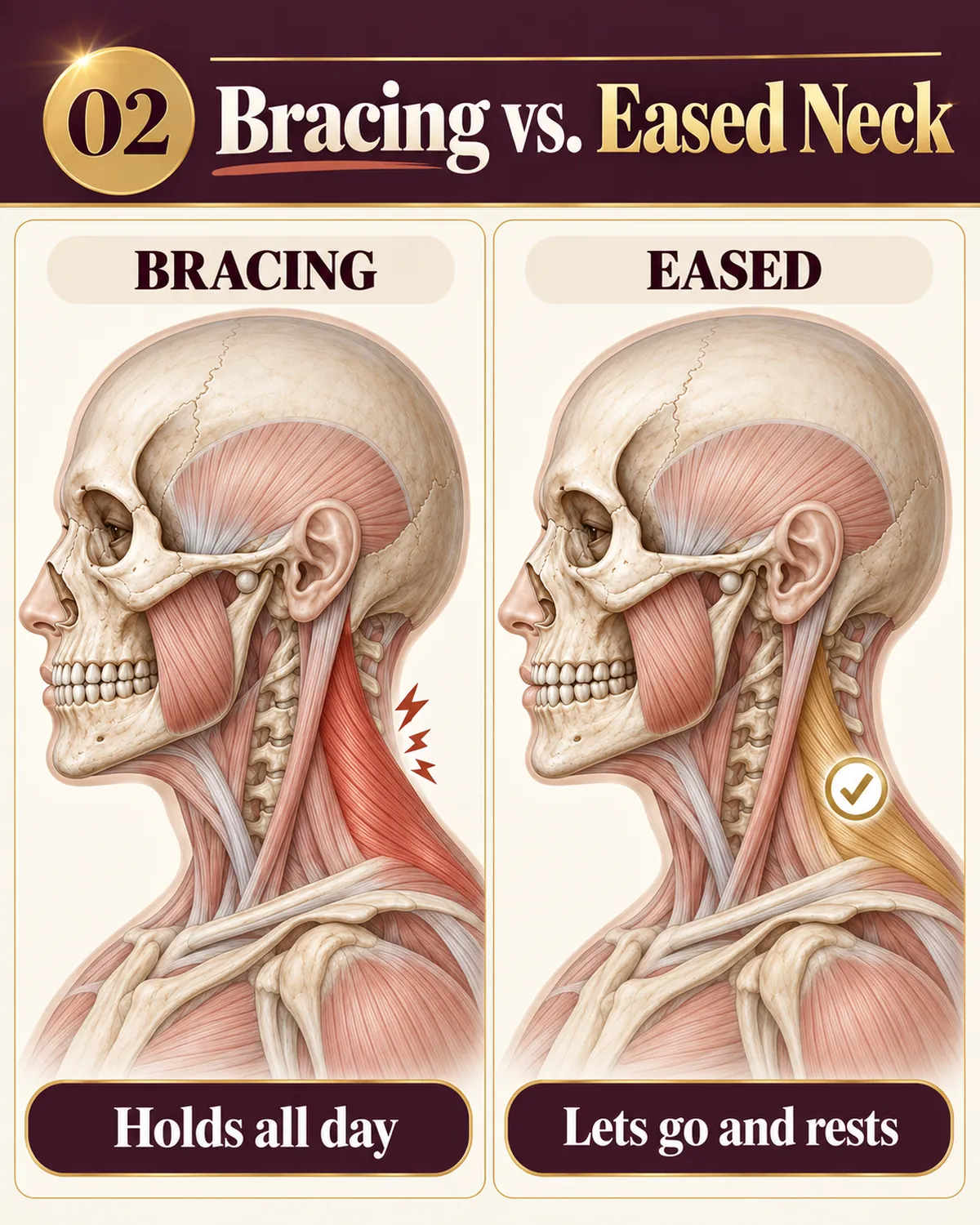
Your head weighs about as much as a bowling ball. The muscles along the back and sides of your neck carry that weight every waking hour, and they never get to put it down.
Holding your head up is background work, like breathing, so the gripping never registers until the evening arrives.
Modern days make the job harder. Every time your chin drops toward a phone, those muscles grip more to keep your head from falling forward. By evening the sides of your neck can feel firm to the touch, and you would swear you feel fine.
How a bracing neck ends up on your face
When the neck grips for hours, the head slowly rides forward. The jaw juts a little to keep the balance, and the chewing muscles pick up steady, low-grade work they were never meant to do all day. The skin and soft tissue of your lower face sit on top of all that effort.
So the face compensates for a frame that is quietly straining. You see the result at the surface: a jawline that looks set, a mouth area that reads as heavy, cheeks that seem to drift downward by dinner. My students often tell me their face feels held by the end of a long day, and that word is exact.
Let me be plain about what I am claiming. I am not describing any hidden system, and nothing here is flowing, unblocking, or being flushed anywhere. I am describing ordinary muscles doing ordinary overwork, in a place you can touch right now.
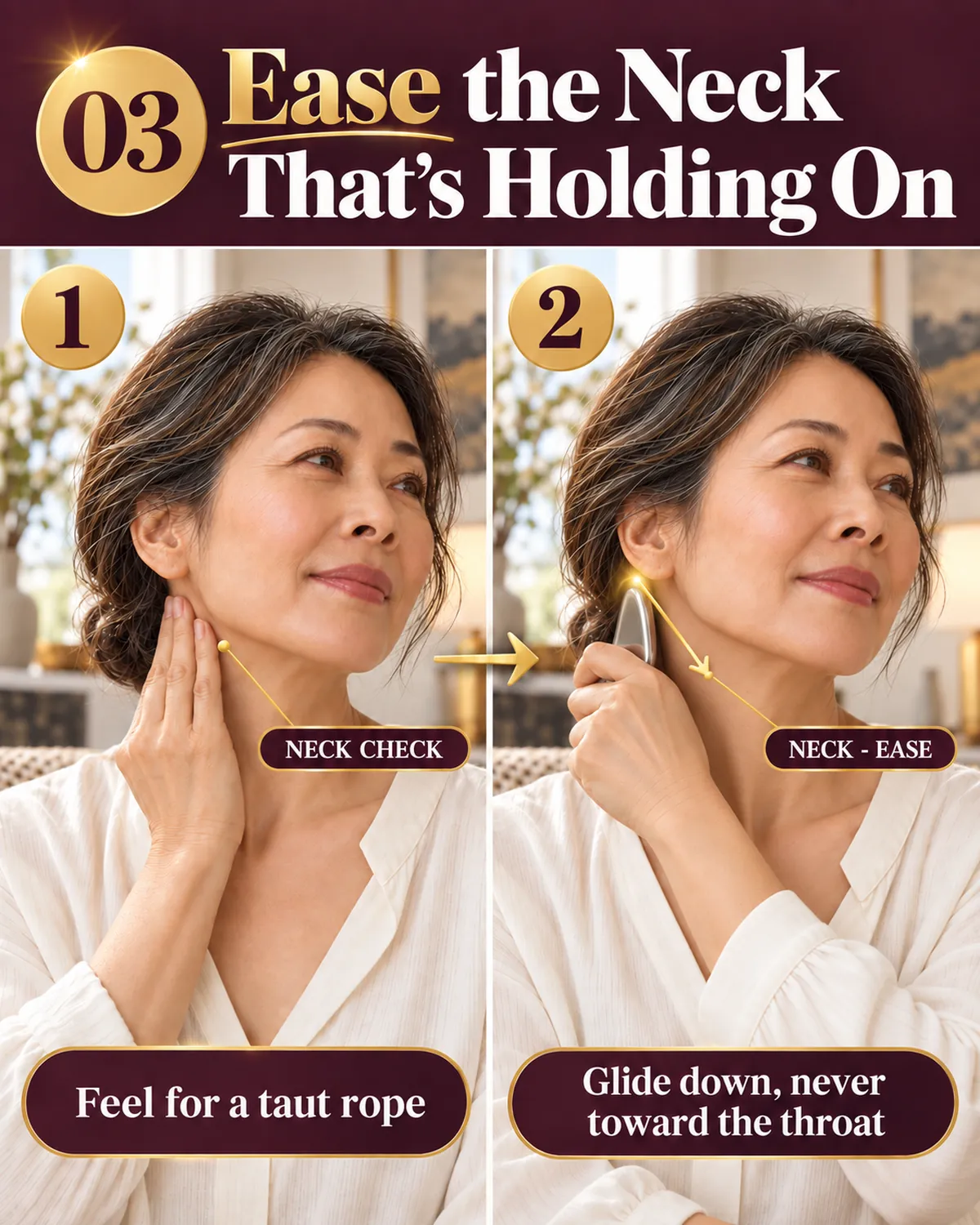
Rest your fingers flat on the side of your neck, just behind and below your ear. Slowly turn your head to look over that same shoulder. If the muscle under your fingers stands up like a taut rope, that rope has been holding your head up all day. Check the other side too, most people find one side clearly tighter.
Where bojin starts, and where it never goes
Bojin is the method I teach for exactly this kind of tension. It comes from a Taiwanese hands-on tradition, and it lives in three decisions: the order you work in, the angle you hold, and the position you choose, all with a comfortable pressure. In my classes, the neck comes before the face every single time, because working the end point before the source is doing the routine backwards.
The tool I teach with is a stainless steel bojin stick, and a dedicated one is coming soon. You do not need to wait for it. The jade or rose quartz gua sha stone already in your drawer will carry you through everything below, because the value lives in the method rather than the object.
A ten-minute sequence, neck first
Plan on about ten minutes, two or three times a week. Use a few drops of facial oil or a slippery cream so the tool glides, and never work on dry skin.
- Prepare Let your back teeth come apart, drop your shoulders, and take one slow breath. Start from your softest posture, not your working one.
- Back of the neck With the broad edge, make small, slow downward strokes along the back of your neck, from the hairline toward the base. Keep the pressure comfortable.
- Sides of the neck Glide from behind your ear down toward the top of your shoulder, several unhurried passes on each side. Stay well behind the front of the throat the whole time.
- Then the jaw Sweep the broad edge along the jawline from chin toward ear, slow and light. If your jaw carries a lot by evening, I keep a full end-of-day jaw release that pairs naturally with this sequence.
- Face last, briefly Finish with a few light outward sweeps across the cheeks. Not featherlight, because that never reaches the tension, and not forceful, because bruising is never the method.
What honestly changes, and what does not
I will not oversell this to you. After a session, most of my students say the neck feels looser and the face feels less held, and the lower face can look a bit more rested for a while. The effect is gentle and temporary. It fades, and it returns as you keep a steady rhythm across the weeks.
This practice cannot erase a line that is there when your face is fully at rest. It cannot change bone or fat, lift tissue that has descended with time, or stand in for medical or dermatological care. What builds over the weeks is quieter and more useful: you start catching the neck grip and the jaw clench during the day, hours before they land on your face.
Your face may not be aging as fast as the mirror suggests. It may just be tired of compensating.
Quick answers
Can neck tension really show in my face?
Yes, in a plain, mechanical way. The muscles along the back and sides of your neck hold your head up all day, and when they grip for hours, the jaw and lower face take on extra work to keep the balance. That extra work is what reads as heavy or tired in the mirror by evening.
Is it safe to use a tool on my neck?
On the back and sides, yes, gently and with oil. The front of the neck and the throat are completely off-limits for tools in this practice. If you have any neck condition, ask your doctor before starting, and keep every stroke comfortable.
Do I need the bojin stick, or will my gua sha stone work?
Start with the stone you own. The heart of this practice is order, angle, position, and comfortable pressure, and your jade or rose quartz stone can do all of it. The stainless steel bojin stick is coming soon.
How often should I do the neck sequence?
Two or three times a week, about ten minutes each. Working every day does not speed anything up; it only skips the rest your skin does well with. A steady weekly rhythm serves you far better than an occasional long session.
Find Your Tightest Link (2-Min Quiz)
Every face compensates differently. Take my two-minute quiz to find where you actually hold tension, and I will send you a custom protocol matched to your answers.
Take the Face Tension Quiz & Get My Custom Protocol →Free · 2 minutes · Your custom protocol, sent to your email
Yu-Ting Lan is a Taiwan-based international bojin instructor and the founder of Héhé Studio. She has taught her bojin method to more than a thousand students, from complete beginners to grandmothers, across Taiwan, Hong Kong, and Malaysia.